
When reality TV becomes a PR crisis in real time
Ashleigh Carson, vice president, Kailee Stickler, senior vice president
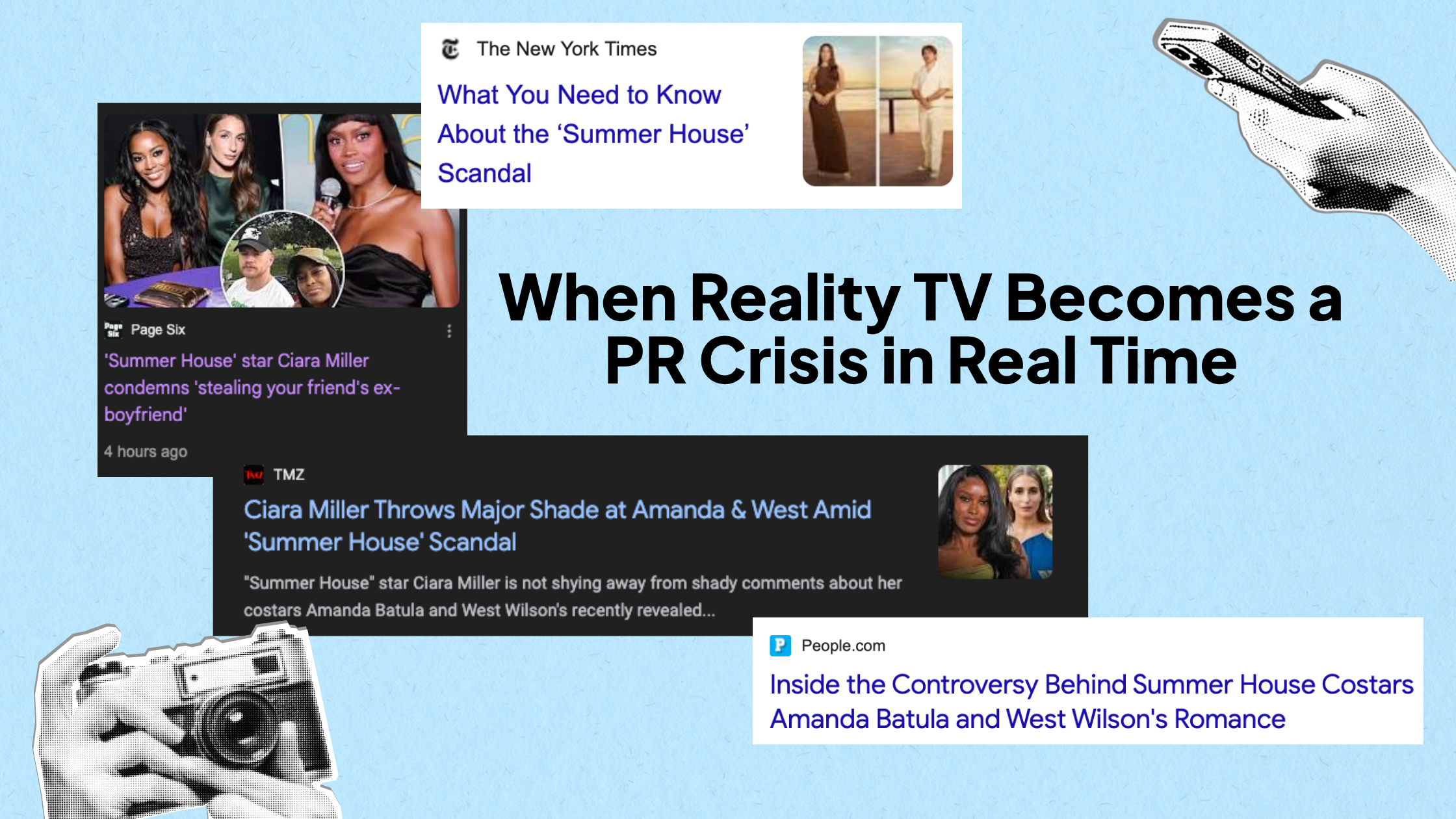
What the “Summer House” West and Amanda scandal aka “Scamanda” teaches about managing public relations in real time
If you’ve been watching the latest “Summer House” drama unfold (and let’s be honest, if you’re here, you probably have), you know exactly how quickly things can go from a casual storyline to a full-blown public opinion spiral. One minute it’s a situationship. The next? It’s a news cycle that for some outweighed the launch of Artemis II. Raises hand in shame, I am the “some.”
Here's a quick scene setter if you are unfamiliar:
A love triangle between best friends Amanda Batula, Ciara Miller and West Wilson.
Ciara and Amanda were best friends.
Ciara used to date West; he broke her heart, but they were starting to re-build their friendship, and we were all rooting for them!
And then, shocker, it was revealed in late March that Amanda and West are now dating via a joint statement made on their Instagram Stories.
The chatter went way beyond Bravo, it was all over TikTok, Reddit, group chats, news headlines, it’s everywhere. Reality TV consistently proves reputation isn’t controlled by the person at the center of the story, it’s shaped by everyone watching it.
Those lessons can also be applied in PR, and where T&C can help with some specific tools related to crisis communications, social listening and media training.
In crisis communications, silence is still a strategy (just not a good one)
One of the biggest mistakes we see in moments like this? Waiting too long or saying the wrong thing first. If you remember during the last Bravo scandal “Scandoval” (past blog here), the initial responses landed flat because they missed the mark on tone, accountability and empathy.
In communications, people aren’t just listening to what you say, they’re judging timing, intent and authenticity. In this current situation, which for the people involved has turned into a full-blown crisis response, their statement didn’t need to be perfect, but like any crisis response it needed to:
Acknowledge the moment and those impacted.
Show awareness of how it’s being perceived.
And, avoid sounding defensive or overly polished.
Because once the internet decides you “don’t get it,” you’re already behind. And, in this case, the internet decided West and Amanda’s statement didn’t get it.
At T&C, if our clients ever need crisis communications support, we work with them, not to spin the narrative, but to meet the moment with clarity and credibility before the wrong narrative is solidified.
A strong crisis communications strategy helps answer:
Should we respond, and when?
What message aligns with our values and audience expectations?
How do we acknowledge without escalating?
A well-crafted response should:
Clarify intent without sounding defensive.
Show accountability where appropriate.
Reframe the narrative toward growth or learning.
Social listening: the conversation starts without you
Here’s the reality: by the time something hits headlines, the conversation has already been happening for hours (sometimes days). And it’s usually happening in TikTok or Instagram comment sections, Reddit threads, or group accounts, breaking down things frame by frame or point by point.
In the “Summer House” example:
TikTok commentary shaped early sentiment.
Reddit threads dissected behavior in detail.
Fan accounts amplified specific narratives.
Without a social listening tool and active reporting and analyzing, you’re guessing what people are actually upset about, which moments are gaining traction and what’s misinformation vs. a real concern.
By tracking conversations through social listening, we can spot shifts in sentiment, understand audience behaviors and respond with information and not in a reactive way. What’s captured on social listening then helps inform a messaging strategy to anticipate risk and uncover opportunities for making smarter campaign decisions.
Media training, because you don’t always get a warning
Not everyone expects to become the center of attention overnight. But in today’s world, it happens all the time. The public sentiment can also change, quickly. Just a few days ago, I was absolutely letting West out of “probation” from his past discrepancies, just like Ciara was (watch this clip to catch up), but now, get your ankle monitor boo, you're back in trouble.
Reality TV personalities, founders, executives and influencers all face the same challenge: You don’t always control when you become the story.
Media training ensures that when that moment comes, you’re equipped to:
Communicate clearly under pressure.
Stay consistent across interviews and platforms.
Avoid language that can be misinterpreted or taken out of context.
In media training, we teach our clients how to bridge from difficult questions to key messages, demonstrate accountability without overexposure and maintain credibility across audiences (internal, news media, stakeholders, etc.).
The three takeaways
If there’s one thing “Summer House,” and honestly, every Bravo show ever, continues to remind us, it’s this — there’s no such thing as a small moment anymore. Anything can become a headline, a trending topic or a reputation-defining narrative. The difference between a moment that fades and one that sticks: preparation.
The individuals and brands who navigate these situations best are the ones who:
Have a crisis communications plan before they need it.
Are actively listening to the conversation around them.
Are trained and ready to show up when the spotlight hits.
Because whether you’re on reality TV or running a company, the rules are the same. You may not control the story. But you can absolutely control how you respond to it.
If you need help with crisis communications preparedness, crafting media statements, staff media training or social listening analysis, T&C is ready to help. Reach out to us at info@thompsonpr.com to learn more about our services.